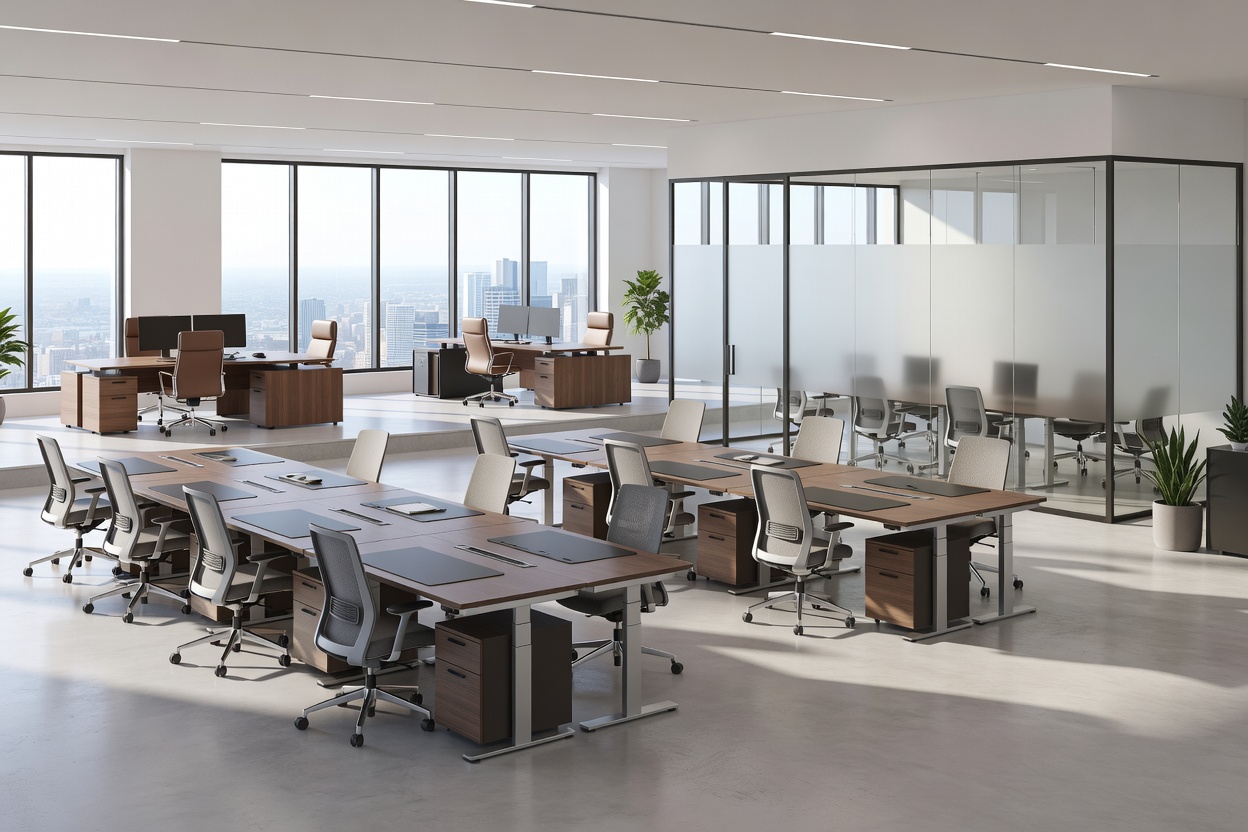
1. Shifting from Emergency Triage to Sustained Operations
When a building suffers severe structural damage, long-term contamination, or an extended commercial lease dispute, emergency measures must transition into steady-state business operations. An ad-hoc hot desk arrangement causes operational fatigue after two to three weeks.
Operating for months in a temporary facility requires adjustments across four core functional areas:
- Ergonomics and Health Safety: Temporary furniture must be upgraded to fully adjustable task chairs, monitor risers, and sit-stand desks to meet European workplace health directives.
- Identity & Client Presentation: Client meetings cannot be held indefinitely in plain emergency suites. Facilities should offer professional reception handling, branded directory signs, and formal client conference rooms.
- Administrative Services: Daily incoming postal sorting, courier dispatch, confidential waste disposal, and secure storage for sensitive physical files.
- Localized IT Hardware Staging: Shifting from emergency cloud workarounds to dedicated local file caches, backup domain controllers, and local storage arrays.
2. Workspace Scaling Models Over Extended Timelines
Cost-efficient long-term recovery avoids booking 100% capacity on day one. A progressive ramp-up structure balances operational demands with budget control:
Phase A: Acute Crisis (Days 1–14)
Only critical personnel occupy the continuity facility. All other staff work remotely or halt non-essential output.
- Capacity utilization: 20% to 30%
- Facility focus: Telecom links, core finance, incident command
Phase B: Stabilized Core (Days 15–45)
Secondary operational teams arrive. Dedicated private offices are partitioned for HR, legal, and billing teams.
- Capacity utilization: 50% to 75%
- Facility focus: Client interactions, vendor administration, daily billing
Phase C: Full Sustained Baseline (Days 46+)
All primary teams are accommodated through staggered shifts, dedicated private suites, and expanded desk allocations.
- Capacity utilization: 80% to 100%
- Facility focus: Full business capability, regular business development
3. Managing Employee Well-Being in Temporary Quarters
Prolonged displacement creates friction among staff. Commutes may be longer, desk layouts differ, and everyday routines are disrupted. To preserve morale and productivity, continuity operators must ensure:
Fixed Desk Assignments: Transitioning from shared hot desking to dedicated personal workspaces gives employees stability and personal space.
Transit Subsidies and Parking: Subsidizing increased commuter transit costs or providing chartered shuttle buses from nearby rail hubs directly to the recovery building.
Acoustic Privacy: Adding acoustic baffling panels and focus phone booths so team discussions do not disturb adjacent focused work.
4. The Demobilisation & Return-to-Base Framework
Transitioning back to the repaired headquarters or a new permanent building requires careful execution. Rushing the move risks a second operational outage:
- ✓ Permanent Facility Handover Audit: Verify power, cooling, cabling, and life safety systems before moving staff back.
- ✓ Data Reconciliation: Replicate data created at the continuity center back to primary data servers before cutting over live connections.
- ✓ Staged Department Return: Move non-critical units back first to confirm primary infrastructure stability under real-world conditions.
- ✓ Carrier Telecom Rollback: Revert SIP trunks and IP routing tables outside normal trading hours with rollback checkpoints.
- ✓ Site Sanitisation and Handover: Securely wipe all local printer hard drives, dispose of physical documents, and surrender access keys.
5. What to Check in Long-Term Standby Agreements
Ensure your continuity facility agreement includes clauses for extended occupation:
- Does the agreement permit rolling 30-day extensions without extortionate penalty surcharges?
- What happens if another tenant invokes during your extended recovery period? (Demand protected tenancy status.)
- Is there an option to lease dedicated basement storage space for archive materials and hardware spares?
- Are commercial business rates, utility surcharges, and cleaning costs clearly specified for month-to-month tenancies?